Box guide
How to Measure a Box for a Custom Order
Inside sizes, packing allowances and common slip-ups, so your next box fits the first time.
Why does the size on a box order matter so much?
A box that is a quarter inch short will not close over the product. A box that is an inch too long lets goods slide around and needs filler to hold them still.
Both mistakes cost money. The first means a remake, and the second means extra paper, extra weight and a bigger shipping bill. US carriers price by size, weight and dimensional (DIM) weight, so empty space is something you pay for.
The fix is simple. Take three accurate numbers, write them in the right order, and send them with a note on how the box opens.
Which number is length, width and height?
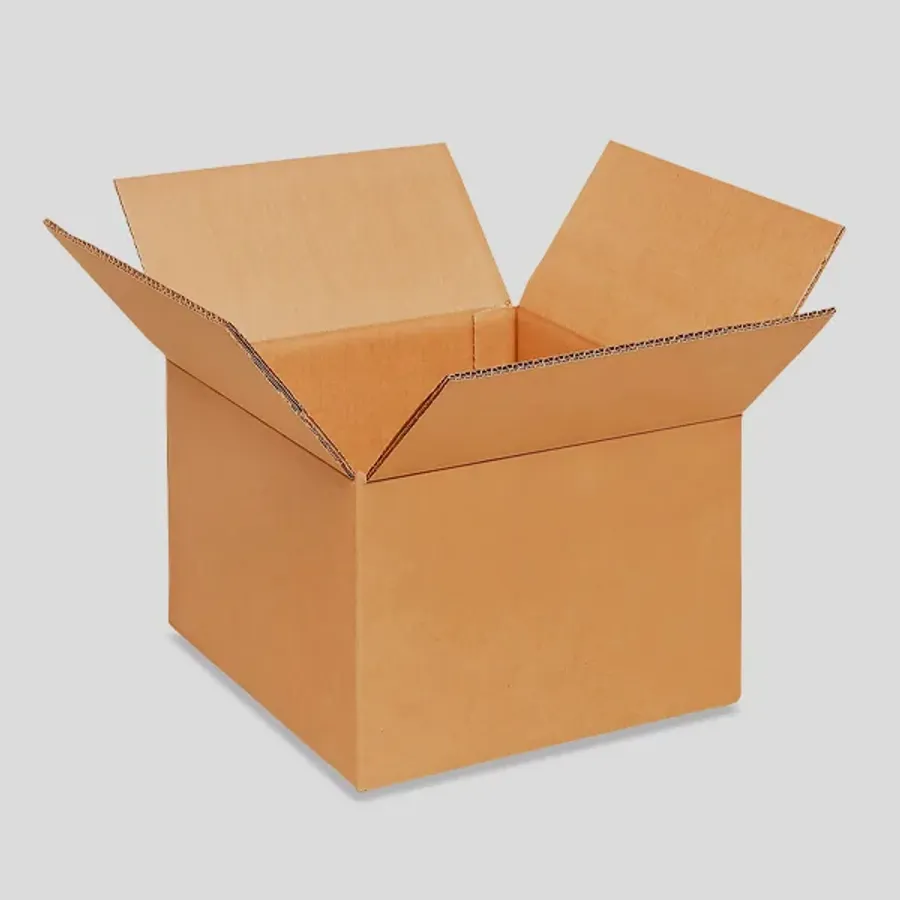
Look straight down into the opening. The longer edge of the opening is the length. The shorter edge is the width.
Height is the depth from the opening down to the floor of the box. It is not simply the tallest side.
That rule matters for boxes that open on the end. A cereal-style carton is tall, but its opening is small, so its length and width are the small numbers and its height is the big one.
Write sizes as L × W × H, such as 12 × 9 × 4 in. If the opening is unusual, add a quick sketch to your notes.
Should I give inside or outside dimensions?
Give the inside size. It is the room your product actually has, and it is how we make every box.
The outside size is larger because the board has thickness on both sides. Add the thickness twice to each dimension. If your box must fit a shelf slot, a cart or a bin, tell us the outside limit too.
The table shows roughly what each board adds, using a box with a 12 × 9 × 4 in inside size. Fold lines can add a little more.
| Board | Approx. thickness | Added to each outside dimension | Outside size of a 12 × 9 × 4 in box |
|---|---|---|---|
| E flute single wall | 1/16 in (1.5 mm) | About 1/8 in | About 12 1/8 × 9 1/8 × 4 1/8 in |
| B flute single wall | 1/8 in (3 mm) | About 1/4 in | About 12 1/4 × 9 1/4 × 4 1/4 in |
| C flute single wall | 5/32 in (4 mm) | About 5/16 in | About 12 5/16 × 9 5/16 × 4 5/16 in |
| BC double wall | 1/4 in (7 mm) | About 1/2 in | About 12 1/2 × 9 1/2 × 4 1/2 in |
How do I measure a product for a new box?
Use a rigid steel rule for small items and a locking tape measure for larger ones. Cloth sewing tapes stretch and throw readings off.
Measure the product the way it will ship. If a candle goes out in tissue, or a hoodie in a poly bag, wrap it first. Include anything that sticks out, such as handles, caps and hang tags.
Then work through these steps and jot down each number as you go.
- Set the item upright in the position it will sit inside the box.
- Measure the longer side across the top. That is the length.
- Measure the shorter side across the top. That is the width.
- Measure from the table to the highest point. That is the height.
- Add your allowance to each of the three numbers.
- Round up to the next eighth of an inch.
- Record L × W × H and note which side of the box opens.
How much extra room should I leave around the product?
It depends on how forgiving the product is. A paperback book can take a snug fit. A glass bottle cannot.
For sturdy goods like folded shirts, books or boxed accessories, leave 1/8 to 1/4 in per side. That means adding 1/4 to 1/2 in to each dimension. A retail carton that slides in and out can be as tight as 1/16 in per side.
Fragile goods need cushioning room. Leave 1 to 2 in clear on every side, so add 2 to 4 in to each dimension. A 3 lb ceramic planter, for example, wants space for paper or foam on all six faces.
If you use a fitted divider, size the box around the divider instead. Our corrugated inserts cut to your product follow that approach.
How do I measure a box I already have?
Say a stock carton works well and you want the same size printed. Open it flat on the floor, push the flaps back and measure the inside from wall to wall.
Read the numbers along the crease lines, not across a bulging side. A box that has been overpacked can stretch, while the creases show the size it was made at.
Look at the cut edge to spot the board. One wavy layer is single wall and two layers is double wall. A flute guide with real thicknesses helps you tell E, B and C apart.
How do I measure round, tall and oddly shaped items?
For a tube or round box, measure the diameter at the widest point and the height from base to top. Round packs are sized as diameter × height, such as 3 × 8 in. See our cylinder boxes sized by diameter for examples.
Tall bottles are measured to the top of the cap, not the shoulder. For a mug, measure across the handle, because that is its widest point.
Lamps, sculptures and other irregular pieces are easiest to handle as a bounding rectangle. Set the item on a sheet of paper, mark its outermost points and measure the rectangle you drew.
How do I convert millimeters and centimeters to inches?
Divide millimeters by 25.4 to get inches. So 305 mm is about 12 in. For centimeters, divide by 2.54.
Do the math on each figure before you round. Turning 11.6 in into 12 in early adds almost half an inch, which can turn a snug fit into a loose one.
We accept metric sizes, so you do not have to convert at all if your supplier lists millimeters. Just say which unit you are using.
Check spec sheets carefully. Many list the bare product, not the product plus its wrap or sleeve.
What should I check on my proof?
Before anything is printed, we email a free design proof with the inside sizes marked. Compare those numbers with your notes before you approve.
Look for three things. The size order should match how the box opens. The numbers should be inside sizes. Artwork should land on the right panel, since swapping width and height also moves the print.
If anything looks off, reply and say so before approving. Fixing a proof costs nothing. For a starting point, browse common box sizes in inches.
What measuring slip-ups come up most often?
Most sizing problems come from a short list of habits. Run through it before you send your sizes. Once your numbers are final, request a quote by email and we will reply within one business day.
- Sending the outside size of an old carton as if it were the inside size
- Swapping width and height on a box that opens at the end
- Missing a cap, handle or tag that sticks out
- Measuring an item before it has been wrapped or bagged
- Rounding inches before converting from metric
- Leaving large gaps around goods that will not be cushioned
- Forgetting the outside limit of a shelf, bin or mailbox slot